
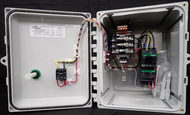
Selecting the right starter requires more than matching a horsepower number. IEC magnetic motor starters are application-specific devices designed to start, stop, and protect electric motors while supporting remote or automated control. Understanding IEC ratings can help contractors, OEMs, facility managers, and equipment owners order a starter that fits the motor, operating conditions, and control system.
What Are IEC Magnetic Motor Starters?
IEC magnetic motor starters combine an electromagnetic contactor, an overload relay, and a control circuit. Energizing the coil closes the contactor and supplies power to the motor. De-energizing it opens the contacts and stops the motor. The overload relay helps protect the motor when excessive current or overheating creates an overload condition.
The “IEC” designation refers to standards developed by the International Electrotechnical Commission. IEC 60947-4-1 covers low-voltage electromechanical contactors and motor starters used in motor and other load circuits. The current edition applies to equipment connected to circuits up to 1,000 volts AC or 1,500 volts DC.
What Does the IEC Rating Mean?
Unlike broad NEMA starter sizes, IEC equipment is selected more closely around the intended motor and duty. IEC magnetic motor starters may be rated according to operational voltage, operational current, horsepower or kilowatt capacity, utilization category, and expected switching frequency.
The utilization category matters because two motors with the same horsepower can place different demands on a contactor. IEC categories account for the load, switching method, current, voltage, power factor, operating frequency, and expected endurance.
Understanding AC-1, AC-3, and AC-4
For most people researching IEC magnetic motor starters, AC-3 is the most familiar utilization category. It typically applies to squirrel-cage motors that start normally and are switched off after reaching operating speed. Pumps, fans, conveyors, compressors, and many common industrial machines often use this type of duty.
AC-1 applies to non-inductive or slightly inductive loads, such as resistance heating, and should not be treated as interchangeable with an AC-3 motor rating. AC-4 covers more demanding operation, including inching, plugging, reversing, and frequent starts or stops. Because AC-4 duty places greater stress on the contactor, it may require a different selection than a standard AC-3 application.
This is why horsepower alone is not enough. The motor’s full-load current, voltage, duty cycle, and starting behavior must also be considered.
IEC Versus NEMA Selection
Both IEC and NEMA starters can provide dependable motor control when selected correctly. NEMA designs generally use standardized sizes with additional reserve capacity. IEC designs are more application-specific, modular, and compact, allowing components to align closely with the expected load and service life.
That approach can make IEC magnetic motor starters a practical option for control panels, OEM equipment, HVAC systems, pumps, conveyors, and installations where panel space or international equipment conventions are priorities.
Information to Gather Before Ordering
Before selecting IEC magnetic motor starters, collect the following information from the motor nameplate and control system:
- Motor horsepower and full-load amperage
- Line voltage and number of phases
- Control or coil voltage
- Application and utilization category
- Starting frequency and duty cycle
- Required overload protection
- Indoor or outdoor enclosure requirements
- Needed controls, pilot lights, auxiliary contacts, or phase monitoring
These details help determine the appropriate starter type, coil voltage, overload protection, accessories, and enclosure. Using the motor’s nameplate current is important because horsepower alone may not reflect every motor design or operating condition.
Final selection and installation should be reviewed by a qualified electrical professional.
Solutions From National Motor Starters
National Motor Starters offers IEC magnetic motor starters for 208V, 230V, and 460V three-phase applications. Solutions include enclosed starters with NEMA Type 1 indoor enclosures, along with polycarbonate options for environments requiring NEMA 3R, 4, 4X, or 12 protection.
Depending on the model, available configurations may include control transformers, Hand-Off-Auto controls, pilot lights, phase monitors, and auxiliary contacts. National Motor Starters also provides an online configurator to help customers narrow their selection by starter type and application requirements.
Quick-ship IEC magnetic motor starters can simplify sourcing by providing a complete enclosed solution instead of requiring customers to assemble separate motor-control components. Before ordering, confirm the voltage, horsepower, full-load amperage, enclosure, coil voltage, utilization category, and control features.
Match the Starter to the Application
The best IEC magnetic motor starters are matched to the motor’s electrical requirements, switching duty, operating environment, and control needs. National Motor Starters supports that process with clearly organized voltage categories, enclosed starter options, configurable features, and product assistance.
Starting with accurate nameplate and application details can reduce ordering delays and help ensure the selected starter is appropriate for the equipment it will control.